Studio Memo - Year 6, Season 2
What’s up everyone. Writing this newsletter from a new platform called Rumicat. It’s like the opposite of Substack - no fluff, not optimized for engagement, just a simple tool to write newsletters. We built it for Nalden and are currently working on a really fun V2. Our theme this last quarter was Zero to One. With everything that’s happening in our world, we don’t believe the ‘low-code’ label is here to stay. So we decided to go back to basics & ask ourselves: ‘If we would start the studio now, what would we start?’ That led us down a big pivot. Here we go.
Finding our ideal clientWe used to frame ourselves as a no-code product studio. That creates an easy story to tell - it’s us vs. traditional coding, 5x faster, weeks not months, stuff like that. Having an enemy to constrast with is proposition gold. But it’s also a bit lazy. Lose the label, and what are you? What are you good at? Who do you serve? I’m quite grateful for us losing this label, because it forced us to be more specific. We took a look at the clients that:
And we figured out they were all experienced founders building a new product. Our way of working is a pretty big contrast from most other developers - we’re always pushing to simplify ideas. That can either be a feature or a bug depending on who you ask. First time founders have a tendency to try to fit in a lot because they are 100% convinced the product wouldn’t work without it. Since they are founders after all, it’s hard to convince them gamification won’t really do anything if you don’t have users yet. It’s also hard to simplify things for SMB businesses building internal tools, because usually the overcomplicated part is their process. If you don’t have the mandate to change that, you end up building a complicated mess of if-statements. The only people who understand the value of simplifying are the people who have done a startup before with other developers. They’ve been wrong before and know long-term planning is useless in the early stages. So we said fuck it! We’ll only work with those those going forward, and will design our service around this use case.
Learning to codeFrom the beginning of the season, our senior team has been starting to learn to code using Next/Node/React. It’s actually going much faster than I initially thought. First of all, the gap between pro Bubble dev & Javascript dev is just… not that big. If you’re on the high end of the skilled Bubble developer spectrum, you’re just a few concepts away from being productive in code nowadays. I’m also amazed by how far you can come with a solid rudamentary understanding of things and let AI handle the rest. Some team members have been using roadmap.sh to learn which is a great resource to understand the landscape and dig just deep enough to understand whether the AI is doing the right things. The best part about this is having access to open source tech built by much smarter people than us. No more hacks, workarounds, slow loading times. Everything is fixable and doable which is going to help us so much with improving the quality of our work.
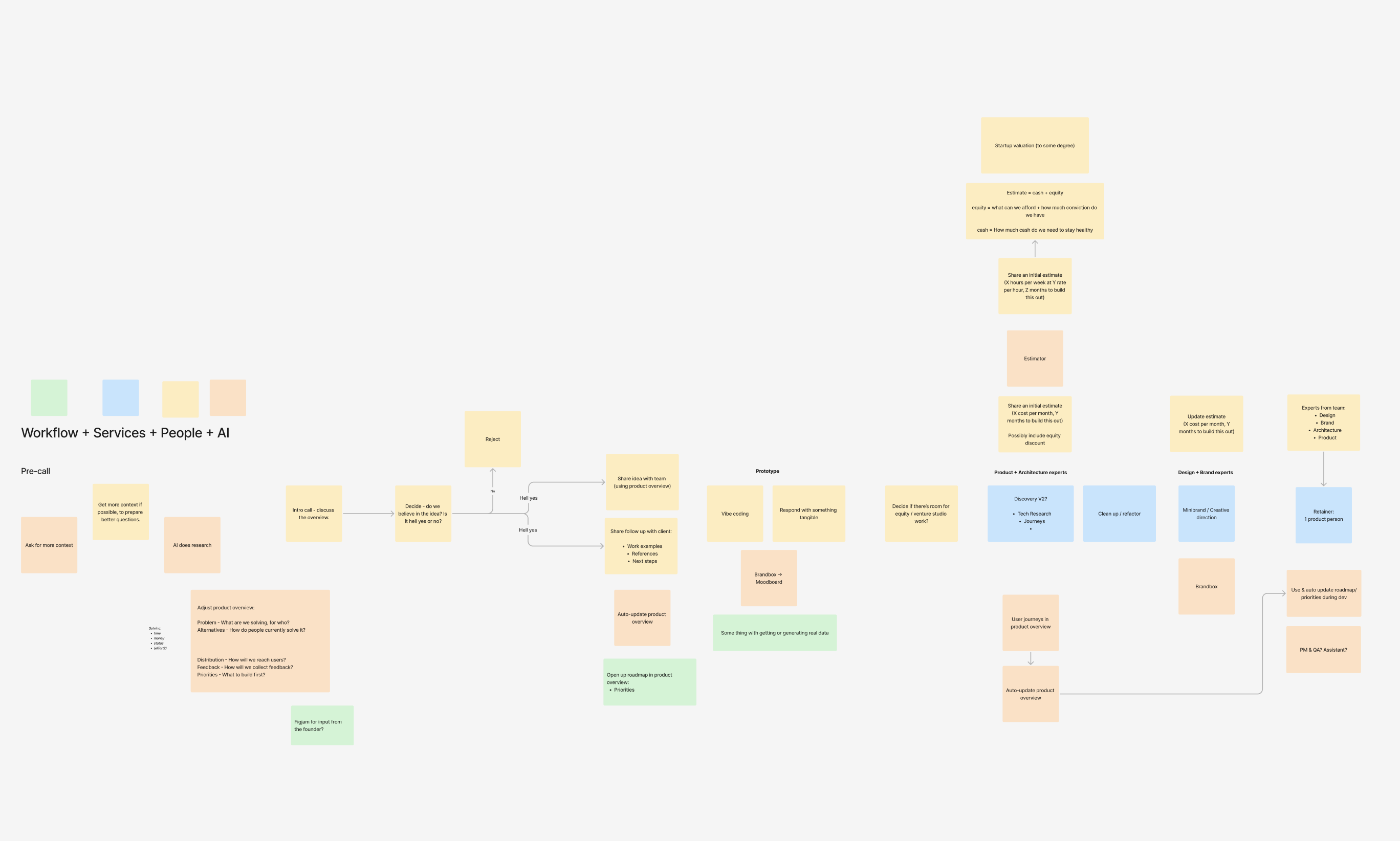
Redefining our workflowI’ve been training Daan on our team to help us out with the day to day as he’s less inclined to get lost in rabbit holes like me. I would very, very highly recommend all idea guys to find a Daan in their lives. As a first step this season, we sat together to redefine our workflow based on what’s possible nowadays. A question that’s constantly on our mind is ‘What will still be useful if the models get better?’ I don’t want to sell a commoditized skill - I think we should sell taste and process. So we’ve settled on a new model. No more designer/developer/pm split. Just one product person + one founder. Assuming the models get better, that one person needs to be great at product, not just design or development. Helping the founder decide what to ship, when to ship it, and understanding what the LLMs are doing. I’ve recorded a walkthrough of what we’re implementing just for fun - you can find it on Youtube over here. Would love to hear other people’s interpretations too and how they’re thinking about this.
BrandingSince we’re focussing on doing 0 -> 1 work, I felt like branding & simple websites had to be a part of our service, especially with what’s possible now. Mainly because I love the idea that a founder can come to us with rough ideas and we handle the rest, but also because it’s a way for us to make sure our products look great. There’s almost nothing I despise more than a client forcing us to work with a brand that’s bad :’) I don’t want to do the fluffy 3 month, company values, stakeholder brainstorm branding sprint stuff. More like a minibrand - one week, fast moodboarding, quick decisions to get to a really solid baseline. It was fun to dive into this. I first started building a taste engine for us to do have a shared library of inspirations within the studio. More about that in the video above. I was able to test it with a new client (S/O Hessel for being the guinea pig) and we worked together on a name, copywriting, logo, etc. I used quite some AI in the brainstorming process - not necessarily to create the final results, but to help generate ideas for visual directions for me to explore. I think there’s a really solid workflow to be found here that skips the fluff.
ResizingAfter mapping out our new workflow, we were left with one glaring issue - our team structure. Over the past 10 months or so, our strategy was to introduce trainees and juniors to the team to grow, expanding the team from 7 to 13. With our senior team in place, we saw this as something that was crucial to figure out. If we could take someone with very little or no experience & help them become a great Bubble dev or designer, we would always have a sustainable way to grow our team. The core assumption we made there is that we would teach people no-code / Bubble. That’s doable with no prior experience, but very different from learning to code Javascript. The other problem here is that our new model only really works with seniors. It’s impossible to do ‘1 on 1 with a founder, fast iterations and solid product skills’ with someone just starting out. We looked at how long it would take for the entire team to get to that level and came to the conclusion that we’d probably bleed the business out trying to get there.. So unanimously we saw only one option. What followed was probably the hardest day since we started the business, as we laid off half of our team. It felt like a huge failure to let people go that you brought on board with big plans. Especially when you see their potential, you like them personally and you’ve hired them because you know they have the right mindset. If you’re reading this and you need some Bubble help - I can really vouch for each person we hired, so please reach out and I’ll connect you.
Small & simpleA smaller, more senior team of 6 also means you need much less process. We took a good look at how much process we introduced these past years, and decided to delete 90% of it in favor of simplicity. So far it’s been great, it feels a lot like a fresh start and a more creative workflow. Every monday, we have a call with the 6 of us, everyone briefly shares something they’ve been building and we give each other some feedback. Other than that, no rules. It’s crazy that it works but somehow it does. The fact that this team has worked together for so long is probably the reason it works. We’ve also decided to move forward with a select group of clients that fit our new MO and we really like working with. I love that being small means we can be more selective, and I think there’s no real reason to build big teams anymore with today’s tech. I’d rather do more with less.
Minimum V3To wrap all of this up, we needed to redo our brand & site. Our previous one was built on Bubble to showcase what can be done with low-code, and since that point is kind of out the window, it was time for something new. We soft launched it behind a little april fools joke called Maximum Studio. Basically a sister agency to Minimum focused on enterprise, filled with fluff and corporate bullshit. This is a really stupid idea Yous and I have had since we started and we’ve always had a good laugh about it. Now that we can easily create slop with AI, this was the perfect time, and the difference between Minimum and Maximum has never been bigger, so it felt right. For the real site, we opted for something extremely simple to contrast what’s expected from digital agencies. I’m pretty happy with it, I think it’s much more memorable than what we had before. In true Minimum fashion, it’s a V1 and we’ll be adding some more detail over time. It’s built in Next, so that’s why it is so damn fast!
What’s next?We have a much better idea of where we're headed now, so it's also easier to see where we need to grow. The team has been able to focus on design and development up until this point, but this new pitch requires us to do more. To make good on that promise, I think everyone should be able to help founders with making better product decisions as well. If we can do that, we can always stay relevant. The theme for this season is Product People. I'll let you know how it went in a few months. Cheers, Mike and the Minimum team. |