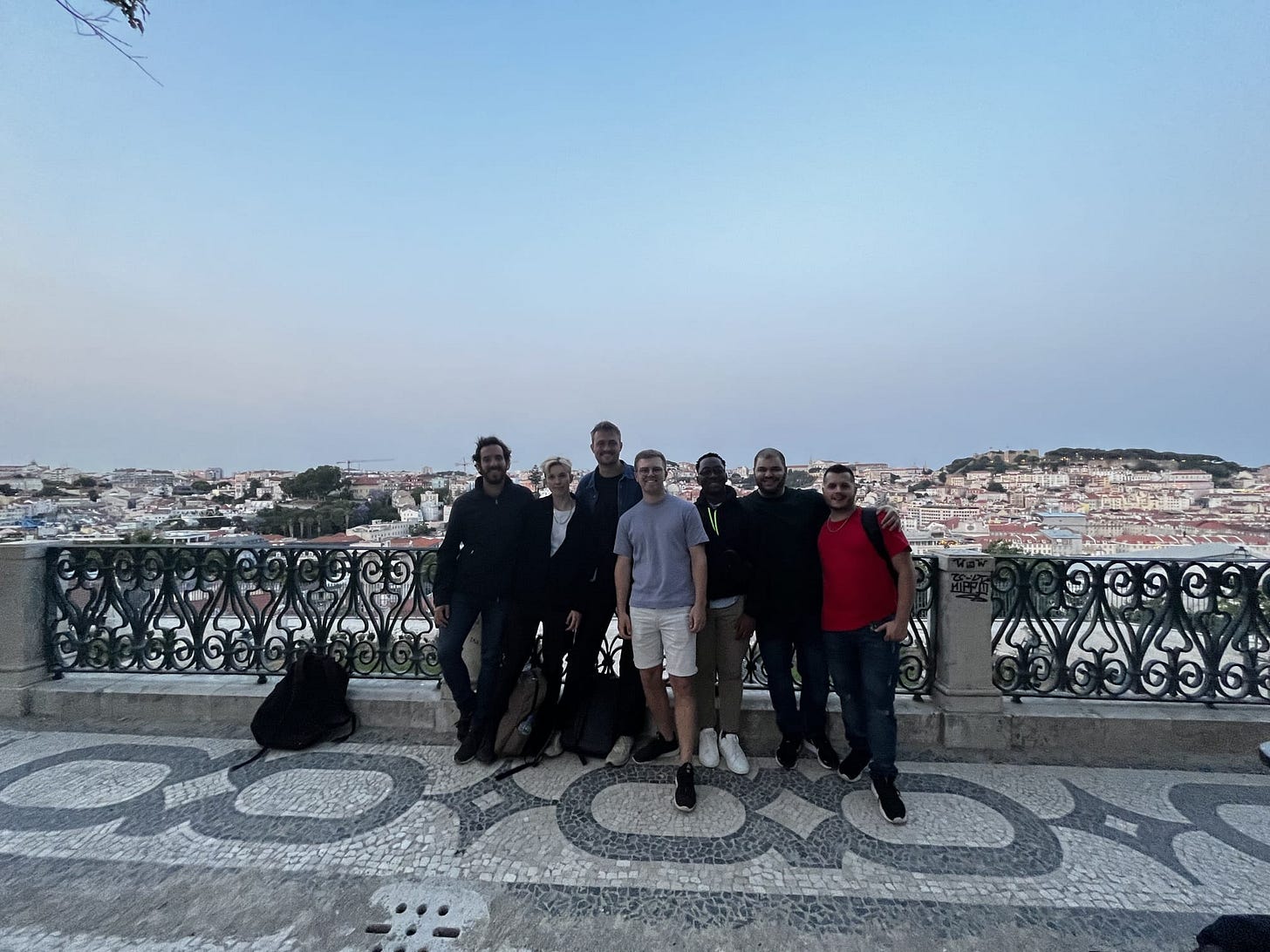
Writing this back in the airplane to Amsterdam from Ericeira, Portugal after another great meetup. It still baffles me to see the team have so much fun together and to see what we’ve built in real life. As always, we coworked, did honest feedback sessions, enjoyed nice dinners and most importantly, laughed our asses off.
Our theme the past few months was push it forward. This mostly meant that we wanted to start including team members a lot more on the strategic and tactical level of the business, so we create more room to grow and realize everyone’s potential.
Here’s how that went:
Less day to day, more leverage Since delegation was such a big topic, for the first time I’ve been mostly removed from the team’s daily activities these past few months. Yous and I decided it’d be easier to split up responsibilities, to avoid micromanaging or having too many captains on each ship and use our respective energy wisely.
This was really challenging for me at the beginning. When bootstrapping a business, it’s easy to develop the mental picture that delivering as much tangible output as possible is directly correlated with doing a ‘good job’ as a founder. You’re just so used to being full with creative work that it feels weird to have space to think, or equally strange to call a spreadsheet a good day’s work.
I’m more used to it now - one tool I’ve been using is making a list of my projects from high to low leverage each week, always starting the week by working on the highest leverage activity I have. This is a great way to force myself to not start building something when I should be hiring, strategizing, reviewing the numbers of having a hard conversation. Building and designing will always feel like the cheap dopamine compared to solving the hard problems.
Restarting the Agency
Our subscription/Product Studio service is still running very smoothly, even more so after Yous is doing an amazing job running it. It’s great to see 100% retention so far and we’ve had multiple talks about doing longer-term retainers. This creates a lot of stability which is definitely rare in our agency world.
To create a funnel for the studio, we re-built the ‘agency’; one-off projects, focussing on smaller projects to show clients what we’re capable of. Kas, who has been with us for almost 3 years now, is in charge of running this, almost like a small business within the business.
The awesome thing about not being bogged down by the day to day was that Kas and I could basically bootstrap this mini business in a few weeks’ time. We expected to take a few months to set this up, but after a month we’d signed 4 clients, I hired 6 freelancers for our freelance pool, worked out the details of pitching it and built MVPs for systems to manage it all.
So far, we’ve already had 2 clients moving from a one-off project to the studio for a long-term collab. That was the crucial flow for us to validate, so this has been a big success.
Get out the suits
In the spirit of delegation, we also decided to give Daan, one of our junior devs with a ton of potential, the responsibility to manage the plugin side of our business, as a side project from client work. This saves me a significant chunk of the week and gives him an opportunity to show his entrepreneurial skills.
To give everyone more feeling for the numbers and context about the business, we now have a separate P&L for the studio (Youssef), the agency (Kas), and plugins (Daan). Every month, they prep and present their respective numbers, we talk strategy and find out what resources everyone needs from each other.
Despite it being a bit corporate, it’s been really great to give people the full picture and a ton of independence in how they run it. Especially as we grow, this will allow us to scale a lot easier than just me crunching the numbers.
Documentation & Peer Reviews
Because we’ve had some new talent in the freelance pool and one of our bigger pain points is collaboration, we’ve tried a bunch of experiments with documenting our apps and peer reviewing each other’s work.
Small mistakes in architecture tend to spiral into huge bugs and issues later on. Peer reviews have proven to be a lot less time consuming than we thought and super effective at influencing the trajectory of an app’s build.
We haven’t completely figured out yet how we incorporate this into every part of the business, but we’re very excited about having more senior to junior collaboration. As we grow, we will need to add more junior talent, so making sure they learn on the job is extremely important.
Content & New Brand
With my schedule freed up, I’ve been working a lot more on how we pitch our services, what we share online, how our cases will look and our long-ago-promised-but-so-hard-to-finish rebrand.
I wish I could tell you it’s done and ready to share, but as these things go, it takes longer than we thought. We are all really excited about the direction though, so I can’t wait until I can share it.
Bigger moves
We’ve been working with our senior dev Pablo since the end of last year, and he’s not only been an absolute powerhouse on just 20 hours/week, he’s also brought some amazing ideas to the table, educated team members and is a great guy to work with.
That makes us really proud of the fact that we’ve (somehow) been able to convince him to join us full-time from July 1st onwards, leaving a great freelance career behind. He’ll be the first technical hire that will work on internal goals; setting our standards, reviewing other people’s work and most importantly; hiring and educating new team members.
This is a hugely important role within the company as we move on and we’re really excited about not having to carry all of that burden by ourselves. Opens up a lot of possibilities.
The coming months I’m starting to feel like strategically you can only work on one thing at a time: growth or quality. Whenever you work on growth, you always sacrifice a bit of quality temporarily, and the other way around when you want to raise the bar.
I also firmly believe that doing amazing work is a flywheel for everything else - it’s easier to hire, to create content, to tell interesting stories and to influence word of mouth if the work is just ridiculously good.
Working with new team members has shown us that a lot of our internal ‘rules’ for good work are not that clear or easy to communicate yet, and dividing up responsibilities means Yous and I can no longer be involved in every decision. With that in mind, we don’t think it’d be smart to push for aggressive growth now, to run the risk of sacrificing our standards.
A few team members have rightly pointed out that if it would be up to me, that standard is an ever-moving goal post and we’ll never feel like we’re entirely there. I agree that that’s not the best framework to work with. So the question remains; what standard exactly?
With the additional help of Pablo and the rest of the team, our coming few months are focused on writing our manifesto on ‘Great work’ - covering client experience, product design and technical design. That should translate to what a ‘Great team member’ is and what ‘Great process’ looks like.
This will help us hold ourselves accountable and align everyone on a new, higher standard, which once defined, I’ll do my best to communicate to the outside world.
The theme for these coming months is They never miss.
I’ll let you know how it went in September.
Cheers, Mike and the Minimum team. |