Studio memo - Year 4, Season 3
Time for another update - writing this from home in Amsterdam as I look back on another, of course, eventful summer. No retreat this time, as I’ll explain later, but we’ve had some great feedback sessions with the team nonetheless. At the beginning of the year, we were eager to kickstart our new service for one-off projects. We vetted and hired 5 freelancers, got 5 new clients in and were off to the races. Back then, it felt like we had this thing entirely under control. One team member was managing both the clients & the freelancers, and the rest of the team was working on the ongoing studio clients. I told myself not to be involved as I was learning to ‘delegate’ (spoiler alert; turns out I wasn’t, I was abdicating)
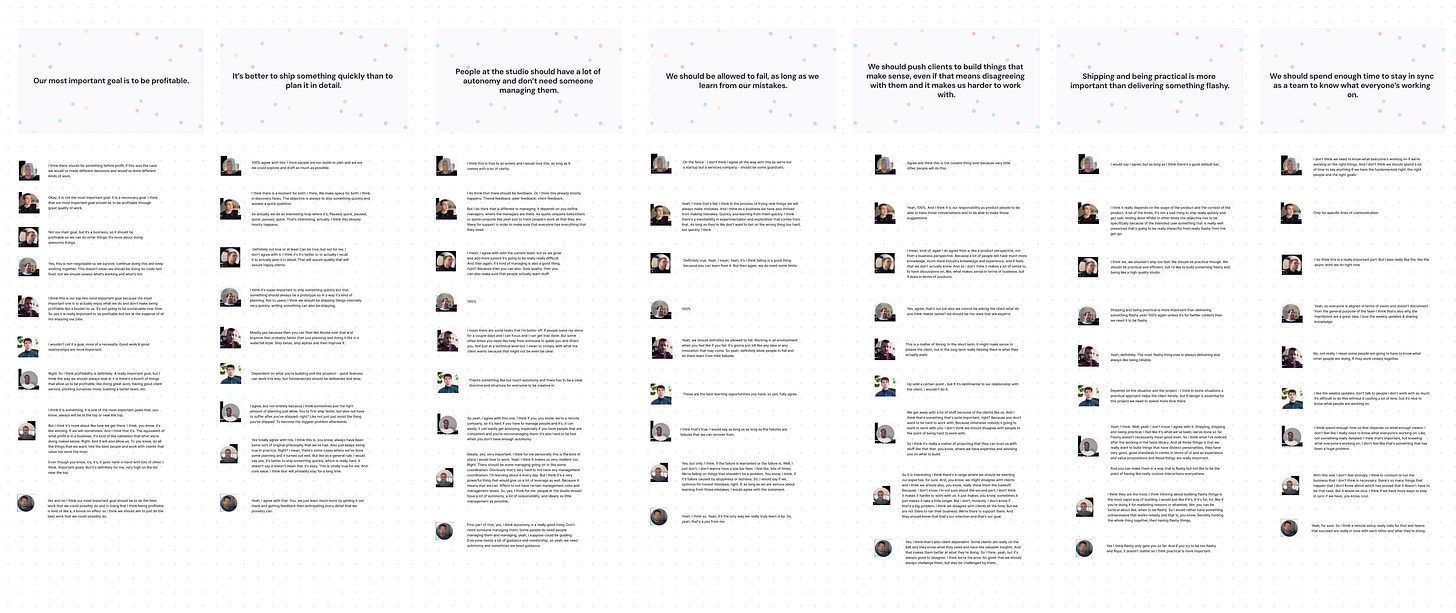
Writing our manifestos To set this bar for how we want to work, we decided it'd be helpful to gather all our principles in 'manifestos'. We wrote one for how we do business, our culture, our design language and we're finishing up our dev and product ones. Although documents like these aren't very important yet when you're a small team, I really believe having some sort of guideline for the team to make decisions can be super powerful as you grow and you need to plant the seeds early. Even now, this has led to some amazing discussions about who we are and what we aspire to be, which I think are a lot easier to do at this smaller scale. One of the most fun parts of this was burning through all the business books/pieces of advice/37signals blogs and other internet threadboi content I've ever read to see what resonated. It's very easy to agree with most things but the interesting cultural differences are in the advice you disagree with. I worked on the culture doc first, so it could serve as a master guideline for the others. You don't force a culture, so I wanted to source it from the people on the team. The best principles are a bit controversial, so I prepared some 'hot takes' for people to go through to see where we'd disagree, like 'Shipping and being practical is more important than delivering something flashy' and 'It's best not to be obsessed with work and focus on your personal life'.
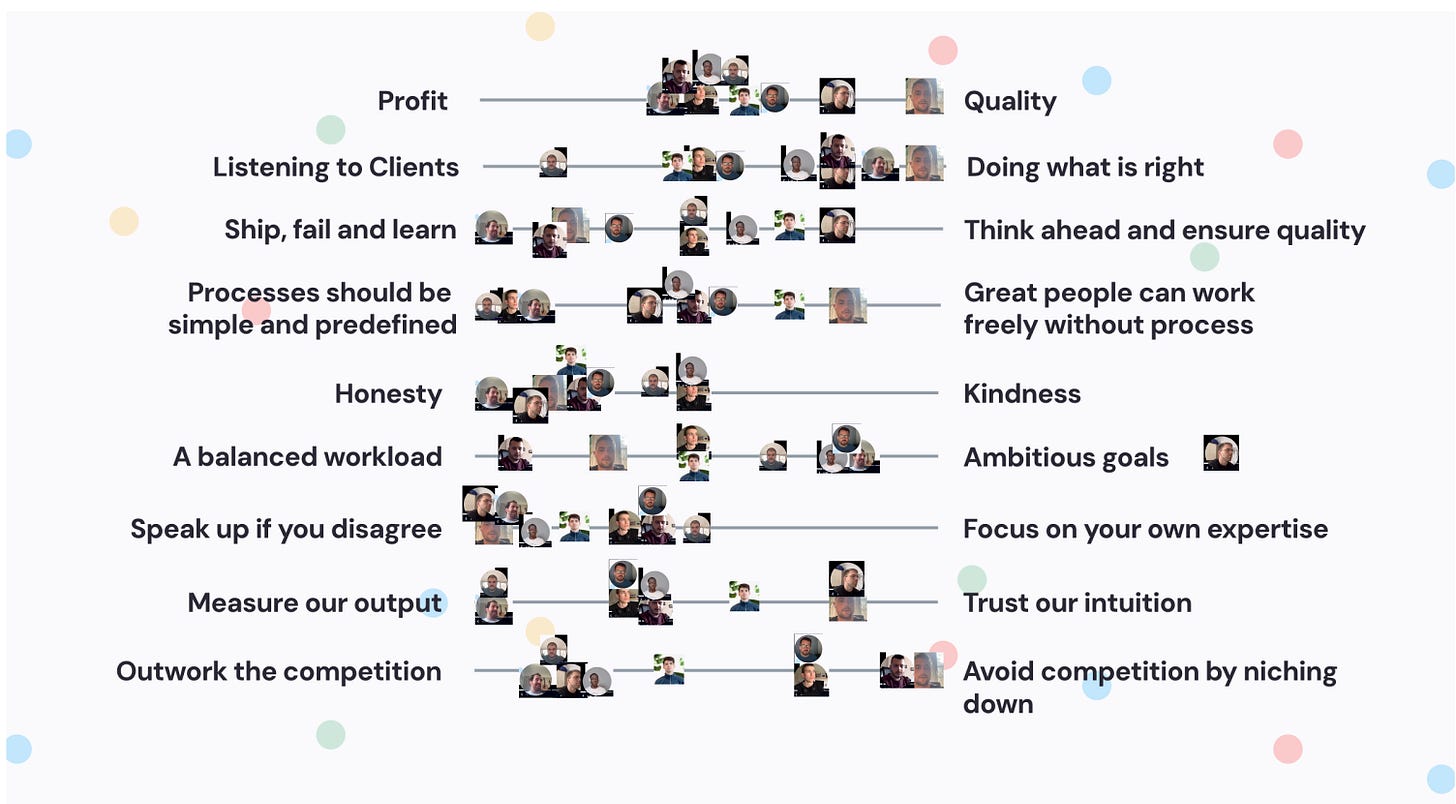
Then I asked the team to put a dot on a spectrum of qualities that are seemingly opposite.
I saw this exercise as a way to reconcile any opinions that are starkly different than our vision. Even if people disagreed, this is the moment to have those conversations, remove any vagueness and make it crystal clear what we value, so people know what they buy into when they join the studio. We settled on a list of principles in four categories; Essentialism, Pragmatic Craft, Play vs. Plan, Process enables creativity. We've already made a bunch of decisions using the principles as a guideline which gives me a lot of faith in it as a tool.
Profit = hard decisions As we wrote down our principles for culture, we also did so for what a healthy business looks like. As you probably already notice, Yous & I aren't really the most shrewd businessmen. We enjoy building the team, hiring people, working with inspiring clients, but we're always happy to invest in seemingly random experiments. We decided we needed to be more focused on the numbers game to actually adhere to our new rules. Sales slowed down a bit as well over summer, so we sat down to see how we could get to a more profitable state. We canceled our team retreat, put plugin development on hold & started training our plugin dev Tomas to be a Bubble dev, so we can improve our overall billable % as a team. That helped, but we needed to do more. We saw that the right approach on paper was to let go Kas, one of our first hires, a very deeply ingrained team member and a close friend of ours by now. We simply had too many non-billable roles and doing sales ourselves was an option at this point. While rationally this made sense, emotionally this was the toughest decision we've ever made. I love being an entrepreneur, but I haven't ever hated it as much as during the weeks surrounding this decision.
The Support service When we started the season, we offered either a one-off project or an ongoing product studio - both pretty big commitments in terms of price. As expected, clients coming from a one-off project started asking about a smaller maintenance retainer. After doing some research on how we could do this low-cost and in a more 'productized' way, we set up a new Support service. It's a very simple workflow - one Notion board, Slack notifications for updates, the client speaks directly to the developer and the client does project management themselves. We save up bigger tickets for future projects. Clients using it have been super happy and it really makes us feel 'feature complete' - we have validated services for every situation, so clients don't really have to leave. They can do a one-off, stay on support for a while, do another project, then scale up to the studio when they raise or get more customers.
AI + Low-code With AI on the rise, we've had a lot of studio clients ask whether we could do 'something' with it. Our junior dev Daan has gone all the way into the rabbit hole of prompt engineering, and we've actually built quite a few awesome AI-powered features, embedded in Bubble apps. We've found that although they seem a bit disparate (AI being more 'hardcore tech' and low-code being 'scrappy'), these two pieces of tech are actually a perfect fit. Since most of the value is in the prompting, building an interface quickly in Bubble makes total sense over traditional code. More and more new leads are also asking about this, so it's great to have a bit of a track record in this area, and it might be a strong niche for us to dive into.
Figma -> Frontend Our lead designer Naël has officially embraced Bubble as we've trained him to be a frontend dev. He instantly started becoming a Twitter influencer with his animation skills in Bubble. It has changed our process completely - since then, we only use Figma to draft ideas, then we go straight into frontend. This is a massive efficiency gain - instead of doing multiple feedback rounds on throwaway Figma prototypes we spend all that time actually building.
The coming months While we're excited about the progress we've made on setting our principles, we realize we have a lot to do before we really live by them. At the same time, most of our issues from the past few months came from not setting the right goals, expectations and lacking a structure within the team for accountability. Feels like we need to 'grow up' a bit as a business before we push for growth again. Our upcoming season's theme is The Operating System. Our goal is to systemize all of our principles, set super clear targets, divide responsibilities and automate as much as we can. We'll review all our processes and start re-implementing them one by one, really focussing on the long-term system instead of the short-term problems. Basically; the boring things that every seasoned entrepreneur tells you to do. We hope they turn out to be right. I'll let you know how it went in '24.
Cheers, Mike and the Minimum team. |